

Join us for this video masterclass featuring expert web designer Paul Lacey as he explores AI as a major shift in web design. Paul explains how AI is raising the baseline for website creation and outlines how professionals can use judgment, strategy, and creative direction to rise above AI slop. His outlook has evolved from skepticism to practical adoption, and he now uses AI tools throughout his web design workflow to reduce repetitive production work and create more time for ambitious, distinctive, client-focused design.
- Video Masterclass: Will AI Replace Web Designers? An Experienced Web Designer’s Honest Take
- Paul’s Perspective on AI and the Future of Web Design
- Three Ways AI Is Changing Web Design
- AI Won’t End Web Design—But It Will Redefine It
- Frequently Asked Questions About AI and Web Design
Video Masterclass: Will AI Replace Web Designers? An Experienced Web Designer’s Honest Take
In this video masterclass, Paul Lacey details why the question “Will AI replace web designers?” deserves a more honest answer than either blind optimism or outright panic. Paul does not argue that every web design career is safe. The fact is that production work is becoming cheaper, some teams are getting smaller, and certain roles will disappear. He believes that understanding AI tools for web designers gives professionals more influence over where they land as the industry changes.
He explains what AI can already do, which parts of web design are most vulnerable, and why human judgment still matters. He also shares what he got wrong while adapting his own workflow, giving other designers a chance to avoid the same false starts. You’ll learn why AI is raising the baseline for website creation, how to recognize generic AI-generated “slop,” and how professional web designers can use AI to create more distinctive and strategic work.
For a practical look at the workflow behind this approach, watch Paul’s earlier Beaver Builder AI masterclass on how to avoid AI slop in web design.
Try Beaver Builder AI in the Demo Sandbox.
Paul’s Perspective on AI and the Future of Web Design
Paul has spent more than 15 years working in web design, WordPress, and digital strategy. During that time, he has worked as a freelance web designer, built and managed an agency, hosted a WordPress podcast, and returned to running a solo web design business that delivers agency-level work. That experience has given Paul a front-row view of how AI is changing web design. His own position has changed quickly. In the middle of 2025, he was skeptical and worried about where AI web design was heading. By March 2026, AI had become part of his daily work. By August, it was built strategically into almost every part of his process.
Three Ways AI Is Changing Web Design
1. AI is Raising the Floor—Web Designers Must Raise the Ceiling
AI website builders have made it easier for almost anyone to create a functional, presentable website. Work that once required professional skills can now be completed in an afternoon for the price of a subscription. The gap between a DIY website and professional web design has become narrower, and that gap is no longer automatic.
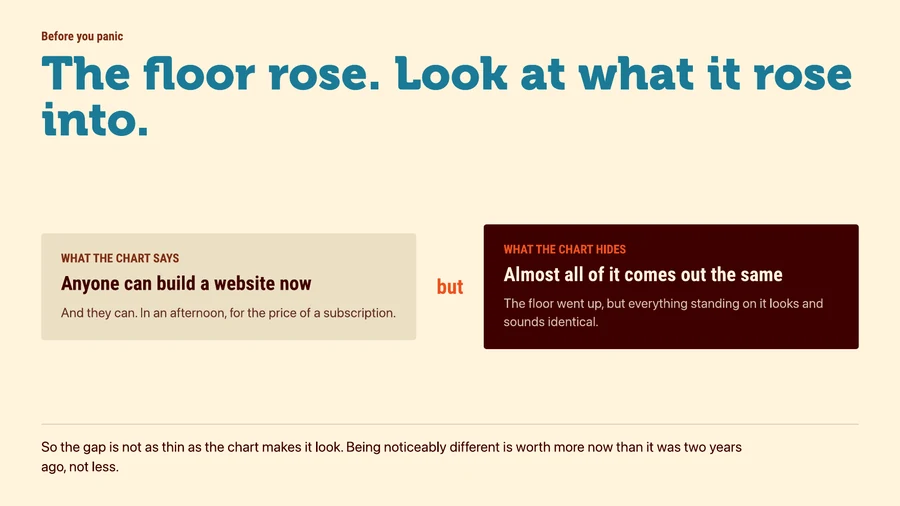
Before AI, most people simply could not build a website. A professional designer’s technical ability created an obvious advantage. Today, almost anyone can produce something, and many of those people are selling their work in direct competition with freelancers and agencies.
AI makes acceptable work more accessible
This rising floor has real consequences. Some production work will disappear, teams may become smaller, and clients with limited budgets may choose AI-generated websites instead of hiring a designer. Lower production costs may also create new demand and make professional help accessible to businesses that could not previously afford it, but there is no promise that new work will arrive quickly enough or benefit the same people whose roles are lost.
Experience can produce better results
Paul argues that experienced designers should use AI to raise their creative ceiling. Instead of using AI only to finish the same project faster, designers can invest the time they save in strategy, creative direction, stronger inner pages, better content, and ideas that previously fell outside the project budget.
“AI is raising the floor for everybody. The opportunity is to use it to raise your ceiling.”
2. Generic AI Web Design Creates an Opportunity to Stand Out
Although AI can produce polished websites quickly, much of its output looks and sounds the same. Paul describes this technically acceptable but interchangeable work as “AI slop.”
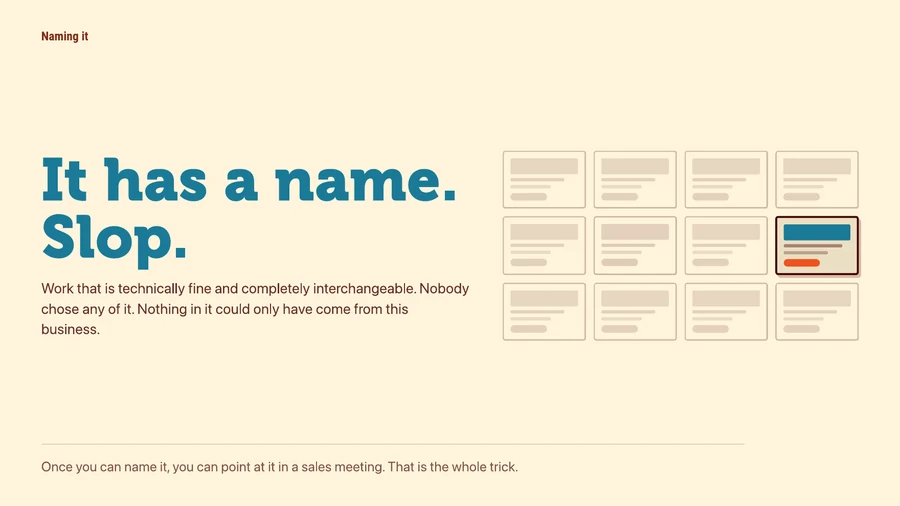
What AI-generated website slop looks like
Common signs include unrelated stock photography, vague headlines, identical three-column layouts, unsupported statistics, decorative icons, glowing visual effects, and phrases such as “trusted expertise” or “solutions tailored to your unique needs.”
The result may not be unattractive or technically broken. The deeper problem is that it contains no meaningful choices and communicates nothing distinctive about the business. When every provider looks and sounds the same, clients are left with one obvious point of comparison: price.
The same AI tool can produce two very different websites
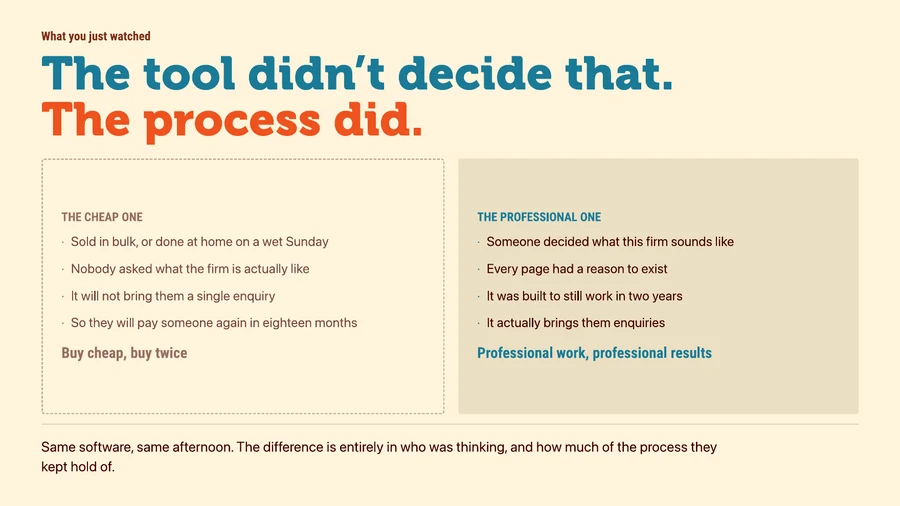
To demonstrate the difference, Paul built two versions of the same family-law page using Beaver Builder AI. The first used the kind of minimal prompt behind many low-cost AI-generated websites. It included generic legal language, predictable benefits, decorative statistics, and imagery that said little about the actual firm.
The second version used the same software but received professional direction. Its design was minimal, considered, and shaped around a specific business. The experiment showed that access to an AI website builder was not the defining difference. Judgment, context, and purposeful choices were.
Distinctive web design is becoming more valuable
As generic AI-generated websites become more common, clients are learning to recognize them. This gives thoughtful designers an opportunity to create work with a clear point of view—work shaped around a particular company, audience, and business objective.
“Being noticeably different is worth more today than it was two years ago.”
3. The Web Designer’s Role Is Shifting From Production to Strategy
AI is reducing the time required for first drafts, page builds, layout variations, repetitive coding, and other production tasks. That does not eliminate the need for experienced web designers, but it changes where their greatest value lies.
Clients still need judgment, direction, and business insight
AI can generate endless options, but it cannot independently decide which idea is right for a particular client. Professional designers bring the context and judgment needed to understand the business, identify the real problem, select the strongest ideas, and turn a website into an effective business tool.
Clients may ask for a website, but what they need is often a business solution. They may need clearer positioning, more qualified inquiries, stronger credibility, or a better way to explain a complex service. AI can generate the components, but a designer must decide what deserves to survive.
The opportunity is greater ambition
When AI reduces the burden of production, designers can stop asking, “What can I realistically finish within this budget?” and begin asking, “What would make this an excellent project?”
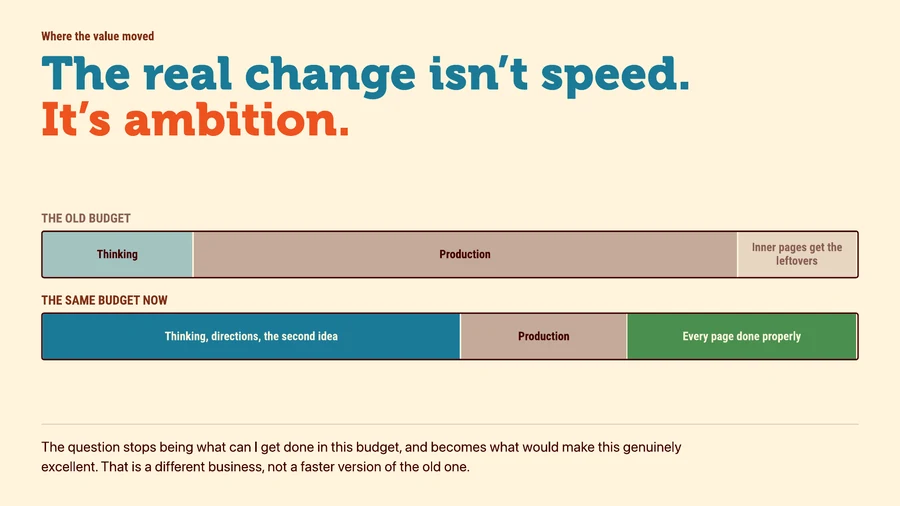
The extra capacity might support a second creative direction, stronger inner pages, an idea that previously could not survive the budget, or a service that sat just beyond the designer’s reach. AI can also take on parts of the job that cause fatigue and burnout, protecting the designer’s energy for work that requires human attention.
“The real change isn’t speed. It’s ambition.”
AI Won’t End Web Design—But It Will Redefine It
AI can already produce a passable website quickly and affordably. It will replace some production tasks, increase competition, and put pressure on web designers whose services are difficult to distinguish from automated output.
But AI does not know what a business truly needs, which ideas deserve to survive, or what will make a website valuable two years from now. Those decisions still require experience, conversation, taste, and accountability.
The strongest response is not to compete with AI on speed alone. It is to combine AI’s production capacity with human strategy and creative direction. Everyone can produce something now. The opportunity for professional designers is to produce something meaningful.
Ready to build your next WordPress website with AI?
Learn more about Beaver Builder AI’s built-in chat and MCP workflows in our guide to the three ways you can build with Beaver Builder AI.
Frequently Asked Questions About AI and Web Design
AI is already replacing some repetitive web design tasks, including first drafts, standard page builds, and layout variations. Paul does not believe this makes every web designer obsolete. Experienced designers still provide the strategy, judgment, creative direction, and client understanding that AI cannot supply independently.
AI is raising the baseline of what almost anyone can create. As website production becomes faster and less expensive, the future of web design will place greater value on original thinking, business strategy, and work created for a specific client rather than a generic audience.
AI-generated websites can be functional and visually polished, making them real competition for low-cost design services. Professional web design stands apart when it reflects meaningful decisions, a distinctive point of view, and a genuine understanding of the client’s business.
AI slop is work that looks acceptable but lacks originality, purpose, or meaningful human choices. It may include generic headlines, unrelated stock images, predictable layouts, vague benefits, unsupported statistics, and copy that could belong to almost any business.
Paul recommends using AI tools to raise the quality and ambition of professional work—not merely to complete projects faster. Designers can reinvest time saved on production into stronger creative directions, better inner pages, more thoughtful strategy, and ideas that previously could not fit within the client’s budget.

Our Newsletter
Our newsletter is personally written and sent out about once a month. It's not the least bit annoying or spammy.
We promise.
Try Beaver Builder Today
Related articles
How to Sell Websites to Clients (Without Talking About Tools)
 -
July 17, 2025
-
July 17, 2025
Struggling with how to sell websites to clients without getting lost in tech talk? Learn how to communicate the real…
Case Study: How One Freelancer Built a Web Design Business with Beaver Builder
-
June 25, 2025
Wondering about Beaver Builder for freelancers? Cami MacNamara operates WebCami Site Design, a successful solo web design business in West…
Best Practices for Managing Web Design Clients
-
January 8, 2025
Managing web design clients effectively is one of the most crucial skills for a web designer, agency, or freelancer. Whether…
Join the community
We're here for you
There's a thriving community of builders and we'd love for you to join us. Come by and show off a project, network, or ask a question.


Since 2014
Ready to build?
The WordPress page builder agencies and freelancers have trusted since 2014. Now with AI.